Last updated 2026-08-21
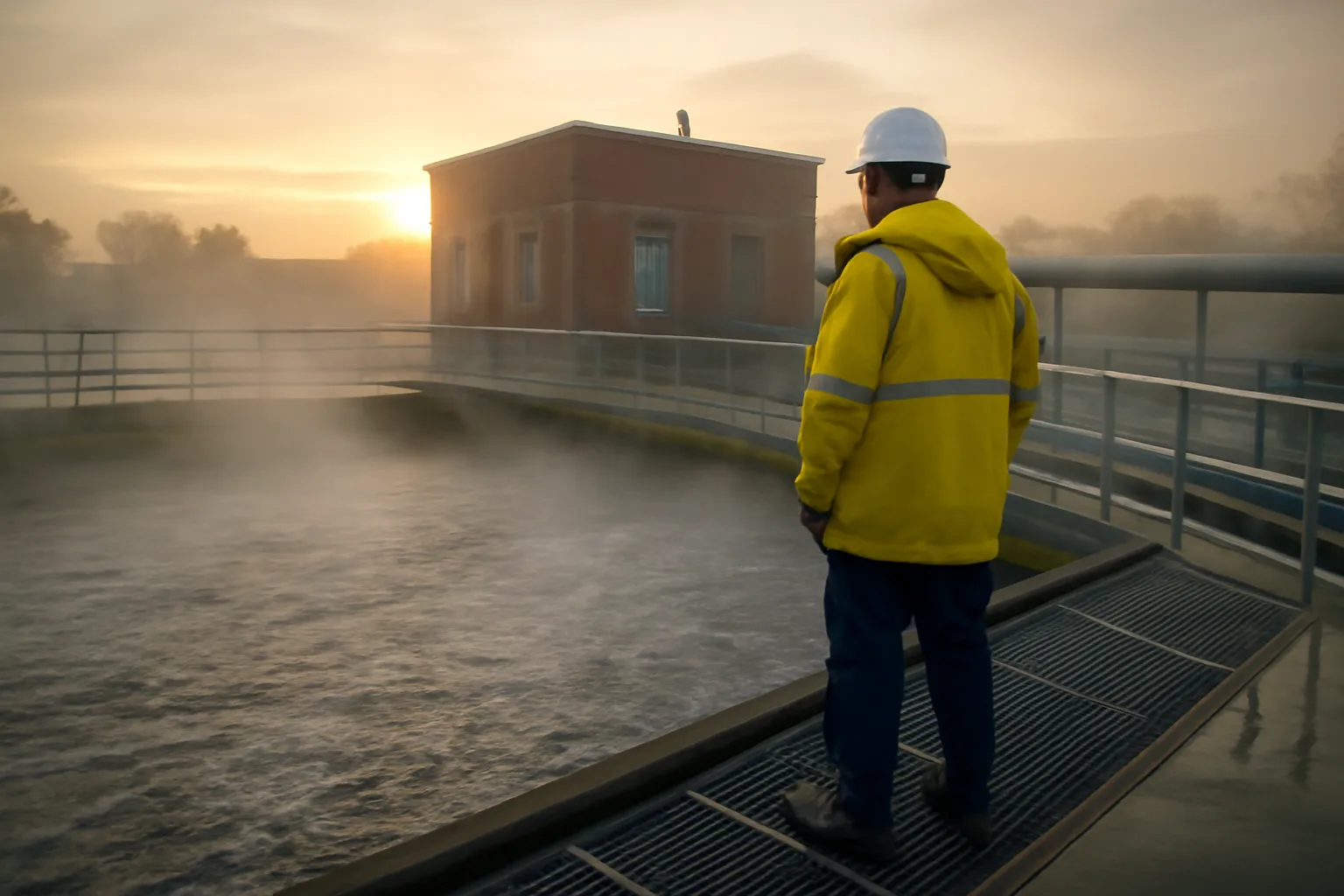
TL;DR
Yes. Connecticut requires a Department of Energy and Environmental Protection (DEEP) wastewater operator certificate to be the certified operator of a treatment plant. The official paper is a Class I, II, III, or IV certificate under Conn. Gen. Stat. § 22a-416, not a national license. You document education and experience, get DEEP approval, then pass the exam. Fees, time-in-grade, and processing times come from the current DEEP packet. Confirm them before you apply.
Do you need a license for wastewater operator in Connecticut?
Yes. You need Connecticut certification to be the certified operator of a wastewater treatment facility in the state. The paper is a DEEP certificate (Class I, II, III, or IV), not a national license and not a drinking water card from the health department. [1] [2]
Towns still say license in job ads. Use their word in interviews. Use DEEP's word on the application.
You can get hired without a certificate. Plenty of people start as laborers, interns, or trainees. A certified operator of the right class still has to be in responsible charge. If that person leaves and nobody else holds the class the plant needs, the town has a staffing problem and a permit problem.
Federal NPDES rules put operation and maintenance on the permittee. 40 CFR 122.41(e) requires a NPDES permittee to properly operate and maintain treatment facilities at all times. [3] Connecticut plants that discharge also need a state discharge permit under Conn. Gen. Stat. § 22a-430, and a certified operator under § 22a-416. [12] [1]
The U.S. Bureau of Labor Statistics is direct: "Water and wastewater treatment plant and system operators must be licensed by the state in which they work." [4]
Skip anyone selling a U.S. wastewater license. EPA does not issue operator cards. ABC may supply the exam content many states use. Only DEEP issues the Connecticut certificate. [5] [2]
If you only want to work under a certified operator, you may wait on Class I. If your name will sit on the staffing plan, get the paper.
Who issues the wastewater operator certificate in Connecticut?
The Connecticut Department of Energy and Environmental Protection issues wastewater treatment facility operator certificates. That work sits in DEEP's municipal wastewater program. [2] [6]
The Department of Public Health certifies drinking water operators. Wrong agency, wrong form, wasted weeks.
DEEP classifies both the plant and the operator. Standardized exams used in many states come from the Association of Boards of Certification. Passing an ABC-aligned exam is still not a Connecticut certificate until DEEP approves your education and experience and issues the paper. [5] [2]
Form names, emails, and who may sign an experience affidavit change. Download the current packet from the DEEP Operator Certification page. Do not reuse a PDF you found in a Facebook group. [2]
If you work at an industrial pretreatment system or a tiny package plant, ask DEEP whether that facility is even inside the municipal operator certification program. Some shops look like a plant and are not classified the way a town WPCF is.
Connecticut is an authorized NPDES state, so the discharge permit and the operator rules both live in state hands, with EPA in the background. [13] [11]
Compare DEEP's structure with another board only after you understand Connecticut's, including guides like wastewater operator license in California.
What classes of wastewater operator certification does Connecticut use?
Connecticut uses four wastewater operator classes: Class I, Class II, Class III, and Class IV. Class I is the entry class for smaller, simpler plants. Class IV is the top class. [2]
If you are the operator in responsible charge, your class has to meet or beat the plant's class. A Class II certificate does not cover a Class IV plant. A Class IV operator can cover a smaller plant.
DEEP classifies the facility with a point method based on processes, flow, and complexity. That class belongs to the plant. You do not pick Class III because it looks better on a resume. You pick the class the plant needs, or the next class you can prove time for.
| Class | Typical setting | Responsible-charge coverage |
|---|---|---|
| Class I | Small water pollution control facilities | Class I plants |
| Class II | Mid-size municipal plants | Class I and II plants |
| Class III | Larger or more complex plants | Class I through III plants |
| Class IV | Largest, most complex plants | Any classified plant |
Confirm your plant's official class with your superintendent or DEEP. Do not guess from design flow. Nutrient removal, sludge handling, and multiple process trains add points. Two 1 MGD plants can land in different classes. [2] [6]
Other states use grades or different numbers. A Grade 2 somewhere else is not automatically a Connecticut Class II. If you are relocating, read wastewater operator license in Texas and Wastewater operator license in Tennessee so you do not assume the names match.
Job ads in Connecticut often say WPCF operator, chief operator, or operator-in-training. The chief operator is the person whose certificate covers the plant class.
What education and experience do you need in Connecticut?
DEEP sets education and operating experience by class. Higher classes need more documented time on process units, or time plus college credit DEEP accepts. A high school diploma or GED is the usual floor, which matches the BLS national profile for this job. [4] [2]
I am not reprinting a years-of-experience grid. Boards change substitutions. The chart someone screenshotted in 2018 is not a source. Open the current qualifications table on the DEEP Operator Certification page and read how DEEP defines operating experience. [2]
Look for these substitution ideas on that official table, then verify each line. Related college credits. An associate degree in wastewater or environmental technology. Sometimes military treatment-plant work. Classroom hours almost never wipe out all hands-on time.
Lab-only work and collection-system-only work often count less than time on aeration, clarifiers, digestion, and disinfection. Ask before you log three years of sewer-jetting as Class II experience.
Your chief operator or superintendent signs the verification. DEEP will not take a self-written log as proof. If a contract firm runs the plant, get the signature from the person DEEP already treats as being in responsible charge.
If you are short on time-in-grade, stay in the lower class and keep a duty log. Inflating the affidavit is how certificates get yanked later.
The occupational series on federal wage tables is 51-8031, water and wastewater treatment plant and system operators. That code is useful for pay research. It does not replace DEEP's experience definition. [10]
How do you apply and take the Connecticut wastewater exam?
Apply to DEEP first. You do not show up at a test site and declare yourself a Class II candidate. [2]
The packet asks for the class, education proof, the signed experience form, and whatever fee is printed on the current application. Use this year's form.
When DEEP finds you eligible, you get authorization to sit for that class. Connecticut has used standardized wastewater treatment exams aligned with ABC content outlines. Question counts, time limits, calculators, and formula sheets come from the candidate notice in force when you test, not from a blog. [5]
Failing means you follow DEEP's current retake rules. Confirm them. They are not eternal.
Study the process you run, then study the ones you do not. Class I still hits clarification, activated sludge basics, disinfection, ponds, safety, and sludge. Class III and IV go harder on process control and nutrient removal.
WastewaterPath has a $149 one-time Class I-IV Exam + CEU Kit if you want one pile of practice material. You can pass without it. Many operators use the ABC need-to-test outline, the plant O&M manual, and a used math book. [5]
Nobody can promise a pass or a seating date. Anyone who does is selling something they do not control.
Bring what the notice says. Leave your phone in the car. If a formula sheet is allowed, it is the official one, not a page you printed at home.
How much does a wastewater operator path cost in Connecticut?
State application and exam fees are whatever DEEP prints on the current application or fee schedule. I will not invent a number that will be wrong next quarter. Read the Operator Certification page and the form. Pay that amount. [2]
The state fee is the small line. Budget also for association or NEIWPCC courses (get a current invoice, tuitions move), a calculator the exam allows, mileage, and later CEUs if your town will not pay. [8]
Skip novelty national license kits. Connecticut will not hang that card on the control-room wall.
People also mean wages when they ask about cost. The U.S. Bureau of Labor Statistics listed a $54,890 median annual wage for water and wastewater treatment plant and system operators in May 2023. [4] That figure is national. The same occupation is coded 51-8031 on the OEWS tables if you want to compare percentiles later. [10] Connecticut municipal scales are often higher than the national median, but the posting and the union contract are the real numbers. Shift differential on nights will beat any national median argument you make in an interview.
Do not buy a four-year degree just to sit for Class I. High school plus plant time is the normal door. [4] Pay for a community college wastewater course only if your superintendent says DEEP will count those credits toward the next class.
How much does wastewater operator cost in Connecticut, in one line: state fees from DEEP, training at whatever the current invoice says, and optional prep. Confirm every dollar with the board or the trainer.
How long does wastewater operator certification take in Connecticut?
Most of the wait is experience, not DEEP's inbox. Class I can be realistic after about a year of documented operating work if the current DEEP chart still lists that kind of time-in-grade and you actually ran process units. Higher classes take multiple years unless DEEP accepts a degree substitution you really have. Confirm the current years for the class you want. [2]
Application review and exam seating add more time. I will not quote a processing clock. DEEP does not publish a guarantee I can reprint. Ask the contact on the Operator Certification page what the queue looks like right now.
If you are starting from zero, plan it this way. Get hired. Use year one to learn the plant and collect signed experience. Sit for Class I when DEEP says you qualify. Stack the additional years (or the official substitution) before Class II or III. Class IV is slow. Jumping from collections to the plant can reset the clock if the work does not meet DEEP's definition of operating experience.
Operators coming from wastewater operator license in Colorado or wastewater operator license in Alabama sometimes move faster on reciprocity. Sometimes DEEP says start over at a lower class. Keep a Connecticut plan that still works if the out-of-state card only gets you a polite no.
How long does wastewater operator take in Connecticut? Plan in years for anything above entry class, and confirm the current experience table before you quit a job or relocate.
How do you renew a Connecticut wastewater operator certificate?
Certificates expire. DEEP sets the renewal cycle and the continuing-education hours. Get the current hour total, the window, and the accepted providers from the Operator Certification page. Do not trust a number you memorized from a coworker. [2] [8]
Renew early. Towns have walked into inspections with a lapsed Class III and no backup.
Keep attendance certificates. DEEP can ask. Toolbox talks may not count. Ask the provider and DEEP before you log them.
If you lapse, you use DEEP's reinstatement steps. That can mean extra hours, a new application, or another exam. Confirm. A friendly phone call does not always restore a two-year gap.
Cheap hours exist through your utility, NEIWPCC, and association meetings. Premium webinar farms are optional. [8]
Put renewal dates on the same calendar as permit reporting. The certificate is part of how the plant stays legal under the discharge permit. [12]
Can you transfer another state's wastewater certificate into Connecticut?
Connecticut can certify you based on another state's card if DEEP decides that program is comparable and you meet Connecticut education and experience rules. That is a DEEP call. It is not an automatic ABC benefit. [2] [5]
Send a verification letter from the other board, your exam history, and the same experience affidavits a new applicant files. Boards care whether you tested or were grandfathered. Grandfathered cards move poorly.
There is no New England stamp that turns a Massachusetts or New York grade into a Connecticut Class III. Read the other board's rules too. wastewater operator license in Arizona is a reminder that western grades will not map one-to-one either.
If DEEP denies reciprocity, apply as a new candidate for the class you can document. It is slower than you wanted. It is better than covering a Class IV plant with a wallet card from somewhere else.
Ask DEEP, in writing, before you resign out of state. Verbal that-should-be-fine is not a certificate.
What is the first year like at a Connecticut wastewater plant?
Year one is rounds, samples, and not defeating an interlock. Connecticut municipal plants are mostly activated sludge, secondary clarifiers, and chlorine or UV. Many have tighter nitrogen limits because of Long Island Sound. Read the NPDES permit on day one. The permit is the real supervisor. [6] [7] [11]
Federal rules say: "The permittee shall at all times properly operate and maintain all facilities and systems of treatment and control (and related appurtenances) which are installed or used by the permittee to achieve compliance with the conditions of this permit." [3]
That is why the rounds sheet exists.
Learn chain of custody. Learn that a bypass in a rainstorm is a permit event, not a clever trick. Learn confined space and lockout before you learn fancy sludge ages. Exam math matters. A wet well can kill you faster than a wrong F:M question.
Keep a personal log of units you operated. You will need it for the DEEP experience form.
Large plants (Hartford region's Metropolitan District, the bigger coastal cities) pay more and specialize you. Small inland WPCFs give you every duty by Thursday. Pick on purpose. Contract operators still need Connecticut paper. The company's out-of-state card does not cover the plant.
See How to start a wastewater operator career in Texas if you want a side-by-side of how another big state hires trainees.
Is a drinking water license the same as a wastewater certificate in Connecticut?
No. A drinking water license is not a wastewater certificate in Connecticut.
DEEP certifies wastewater treatment facility operators. The Connecticut Department of Public Health certifies drinking water treatment and distribution operators. [2] [9]
Two applications. Two exams. Two renewal clocks. A DPH water treatment certificate does not make you the certified operator of a WPCF. A DEEP wastewater certificate does not make you the certified operator of a community public water system.
Some people hold both. That is two fees and two CEU stacks. Do it if your utility actually runs both systems. Skip it if you will only ever work wastewater.
Sewer and pump-station work is a related job. It is not automatically DEEP operating experience. Ask before you count it.
Wastewater plants exist as NPDES facilities under the Clean Water Act. [7] [11] Drinking water operator rules hang off the Safe Drinking Water Act and DPH. Different federal hook. Different state shop. File the right paper.
What should you study for the Connecticut wastewater operator exam?
Study the plant O&M manual, the NPDES limits, and the ABC wastewater treatment need-to-test outline for your class. [5] [6]
Do the math on paper. Pounds formula, detention time, WAS and RAS, chlorine dose, pump calculations. If you cannot go from GPM to MGD without a phone, you are not ready.
Ignore guaranteed-pass question dumps with no source. A lot of them are old exams from other states with the wrong terminology.
Safety, basic lab (pH, DO, settleometer, chlorine residual), and upset troubleshooting show up at every class. Nutrient removal shows up more as you move up.
If you want a structured kit after you already have the free outline, the same $149 Class I-IV Exam + CEU Kit is at /start. Optional. The document you actually need is DEEP's current application and qualifications table. [2]
Confirm every fee, every experience year, and every exam rule with DEEP before you spend money or quit a job. WastewaterPath is an independent publisher. It is not the board, not a law firm, and not a treatment contractor.
Frequently asked questions
Do you need a license for wastewater operator in connecticut?
Yes. Connecticut requires a DEEP wastewater treatment facility operator certificate to be the certified operator of a classified plant. Job ads say license. The board says certificate. You can often start as a trainee under a certified operator. You cannot be the operator in responsible charge without the class that matches the plant. Confirm current rules on the DEEP Operator Certification page.
How much does wastewater operator cost in connecticut?
DEEP sets application and exam fees on the current form. Those numbers change, so read the form. Add training invoices from NEIWPCC or associations, a legal calculator, travel, and later CEUs. Optional exam prep is extra. The national median wage BLS published for May 2023 was $54,890, which is pay, not your cost to get certified. Confirm every fee with DEEP before you pay.
How long does wastewater operator take in connecticut?
Plan on about a year of documented operating experience before Class I if DEEP's current chart still reads that way and your duties count. Higher classes take multiple years unless an official degree substitution applies. Application review and exam seating add weeks to months. DEEP does not publish a processing guarantee here. Confirm time-in-grade on the current qualifications table.
Is it called a license or a certificate in Connecticut?
Certificate. Conn. Gen. Stat. § 22a-416 and DEEP run a certification program. Employers and the BLS still say license. Use certificate on DEEP forms. Use whatever word the job posting uses when you apply for work. The card that matters is the DEEP class certificate, not a national wallet card.
Does Connecticut use ABC wastewater exams?
Connecticut has used standardized wastewater treatment exams aligned with ABC content outlines. DEEP still decides eligibility and issues the certificate. ABC membership is not a Connecticut certificate. Read the candidate notice DEEP or the exam vendor gives you for question count, time, and calculator rules.
Can I work at a plant before I am certified?
Usually yes, as a trainee, laborer, or assistant under a certified operator. The plant still needs a person in responsible charge who holds the right class. Ask the superintendent how the staffing plan is written. Do not sign reports as the certified operator if you are not.
Do I need a college degree for Class I?
No. A high school diploma or GED is the usual education floor, which matches the BLS national profile. Degrees help later if DEEP's substitution table gives you experience credit toward Class II, III, or IV. Confirm the current table. Do not pay for a bachelor's degree only to sit for Class I.
What is a chief operator in Connecticut?
The chief operator is the certified operator in responsible charge whose class covers the plant class. Shift operators may hold a lower class. The title on your union card is not the same thing as DEEP's class. Ask how nights and weekends are covered in the permit and the staffing plan.
What happens if my Connecticut certificate expires?
You follow DEEP's renewal or reinstatement steps. That can mean extra continuing-education hours, a new application, or retesting. Confirm the current process. A lapsed card can leave the plant without a legal operator in charge. Do not wait for an inspection to notice the date.
Does sewer or collection experience count toward certification?
Often only in part, or not as full operating experience. DEEP defines operating experience around treatment process units. Sewer cleaning and pump-station checks may not equal aeration and clarifier time. Read the definition on the current application and ask DEEP before you claim three years of collections as Class II time.
Where do I send the Connecticut wastewater operator application?
To DEEP's wastewater operator certification program, using the address or electronic method on the current application. The Operator Certification page is the source of truth. Do not send wastewater packets to the Department of Public Health. That office handles drinking water operators only.
Is there a national wastewater operator license?
No. EPA does not issue wastewater operator cards. States certify operators. ABC writes exams many states use. Reciprocity is a state-by-state decision. Anyone selling a national wastewater license is selling you a story.
Are CEUs required to renew in Connecticut?
DEEP requires continuing education to renew. The hour count and accepted providers are on the current renewal instructions. Do not copy a number from a coworker. Keep attendance certificates. In-house meetings may not count unless DEEP accepts them.
Can I skip Class I if I already have a degree?
Only if DEEP's current qualifications table lets you enter a higher class with the credits and experience you actually have. Many people with degrees still test Class I first because their plant time is short. Confirm with DEEP before you apply for Class III on a diploma and six months of intern work.
Sources
- CT DEEP, Operator Certification program page: DEEP administers Connecticut wastewater treatment facility operator certification, applications, classes, and renewal instructions.
- eCFR, 40 CFR 122.41 Conditions applicable to all permits: 40 CFR 122.41(e) requires NPDES permittees to properly operate and maintain treatment facilities at all times.
- U.S. BLS, Occupational Outlook Handbook: Water and Wastewater Treatment Plant and System Operators: BLS reported a $54,890 median annual wage (May 2023) and states that operators must be licensed by the state in which they work.
- CT DEEP, Municipal Wastewater program page: DEEP's municipal wastewater program oversees municipal treatment facilities and related operator certification.
- U.S. EPA, NPDES Permit Basics: Municipal wastewater plants discharge under NPDES permits that require proper operation of treatment systems.
- NEIWPCC, Wastewater program: NEIWPCC provides wastewater training used by New England operators, including Connecticut staff seeking exam prep and contact hours.
- U.S. BLS, OEWS occupation 51-8031: Federal wage estimates for water and wastewater treatment plant and system operators are published under SOC code 51-8031.
- U.S. House Office of the Law Revision Counsel, 33 U.S.C. § 1342: 33 U.S.C. § 1342 is the Clean Water Act NPDES permitting authority that covers wastewater discharges.
- U.S. EPA, NPDES State Program Information: EPA lists authorized state NPDES programs; Connecticut administers NPDES inside the state.